The Kent Coast Cycling Lesson
‘That’s it, we’re finished. We’re really finished.’
There, I’d said it. Solid dread softened into a wobble-legged vertigo as I jumped out of my imaginary aeroplane. So many times had I visualised this moment, anger and frustration adding in layers as I built the courage to face the onslaught that would ensue. Or Sophie might just laugh it off. She might not believe I really was bailing out; I could hardly believe it myself. I’d often thought I wouldn’t make it back down to earth in one piece.
But there was no outburst, nor the knowing smile at heard-it-all-before empty threats. Sophie stood up and shot me a cold look. She turned to the bay window and gazed down at the roundabout below, all the while clenching then unclenching her fists. The silence was intensified by the buzz and bustle of the traffic outside. ‘Fine by me. Absolutely fine.’ She walked out of the room.
Sophie was much calmer than I’d expected; much calmer than she usually was when we split up. This time, though, it felt different: hard, real, beyond. The initial exhilaration and fear subsided as my mental parachute opened and I looked down at the floor far below. I was swaying now, dizzy, and my head was empty.
———————————————————-
Bad news travelled fast, but not far. It reached a few friends and the friendlier fringes of family, all of whom probably thought it was just another tiff. Our hopes of a quick separation – sell the flat, split the money, shake hands and move on – fizzled out as our lives faltered into uneasy trickles, on hold and in hock until we could find a buyer. Conversations spiralled into slanging matches we didn’t want and couldn’t stop. Somewhere along the line all the tunes that lived in my head disappeared, replaced by a reverberating We’re really finished.
Why were we splitting up? I no longer remembered. Living together had become so difficult I could no longer see or think clearly. I only know there was no love or respect left to tear us apart. They say the only thing in a marriage that can’t be remedied is contempt.
Neither of us could afford to move out, so we each endured a two-year non-separated separation, living separate lives in separate rooms in a flat no one wanted to buy.
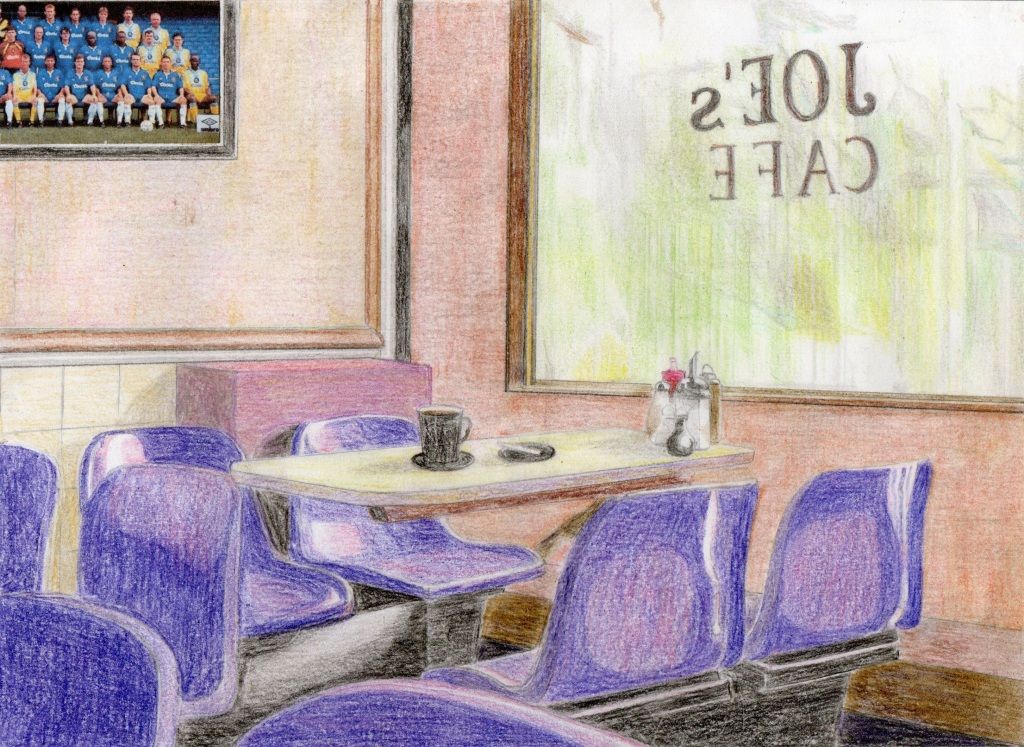
If I finished my proofreading night shift before Sophie left for the day, I’d sit in a café where I practised the noble art of making a mug of tea last a long time. Sometimes I’d stay on at the ad agency, slowly turning the pages of the reference books we used for checking spellings and place names; piles of dictionaries, atlases and encyclopaedias. There was even a Reader’s Digest World Atlas with its green fabric cover, the same edition as the one I got for passing the eleven plus in 1969 and now hopelessly out of date. I breathed its musty pages and toured the world in my mind’s eye, then started on Collins’ UK Road Atlas, the grey patches of conurbations and the white spaces in between, wishing I were there, not here.
Weekends are meant to be the best time
The weekends were the worst. I soon realised I couldn’t mope around town all day just killing time. I tried to think of better ways to get to Monday. I thought of the atlases in the studio at work, the maps depicting the sharp delineation between cliff and surf, blurred estuaries and tidal mudflats. Gradually, I formed the idea of a temporary escape of sorts by travelling the coast of Britain. Then I’d at least get my weekends back, and that would be a start.
My getaway vehicle turned out to be right under my nose. Sophie had acquired a spare bike from somewhere – and had left it in the hallway at the foot of the stairs to our flat. She didn’t actually say I could use it, but then I didn’t actually ask. I’d ridden it to the shops a couple of times though and nothing had been said.
The idea of enclosing horrible things by cycling around them appealed. Maybe I was going loopy; working nights can mess-up your mind – you become a sleepless, sleepwalking, zombie.
As a lifelong lover of longitude and latitude, place names and symbols, I’d always enjoyed going on imaginary expeditions by map, using the thin pale brown contour lines that were sometimes angrily, dramatically close-bunched to depict steep hills, or meandered far apart in laid back, wide shallow valleys. Along shorelines, canals and paths populated by an assortment of locks, churches and public houses. Like many cartophiles, I would sometimes get all giddy looking down on a map from above, as though I were in a hot air balloon, able to see for miles and miles around.
So it was a simple step from made-up journeys to contemplating an actual one. I started by copying maps from the atlases at work. I told myself that one day, this journey would be real, not just traced with a pencil, and that each turn of the pedal would mark a step towards being free.
The journey of a thousand miles begins with a single… list
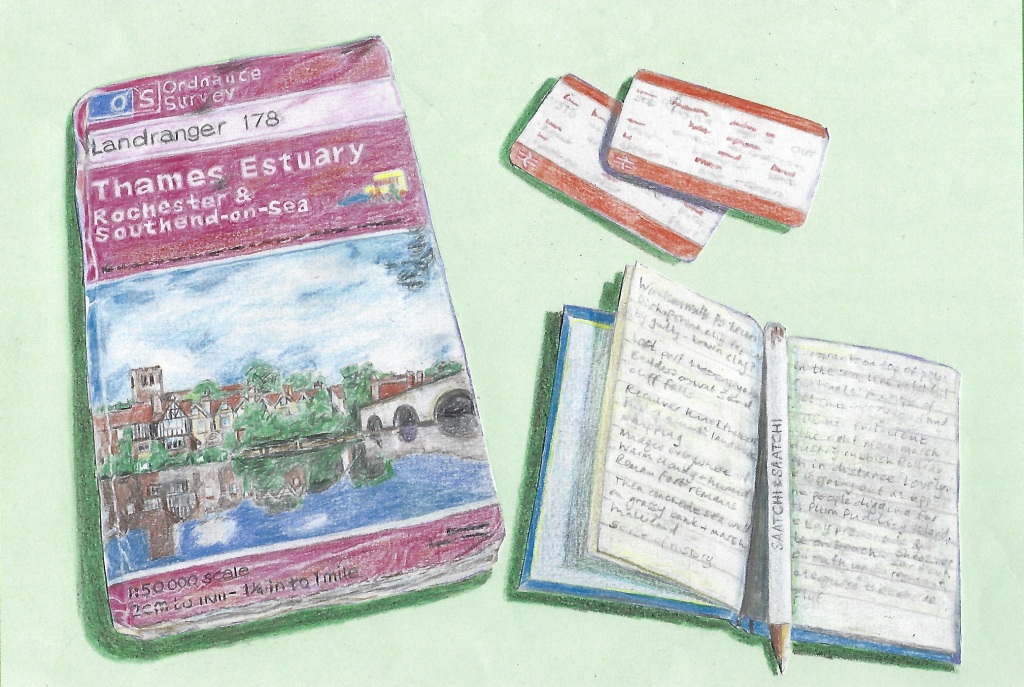
I made a list of what to take with me. It was a short one. A bike spanner and a rudimentary puncture kit, though I wasn’t sure how to use either. Clearly, I’d never been much good at repairing anything. I would need a notebook and pen, too. And a camera. I couldn’t afford a proper one, so I opted for the disposable kind. It turned out to be a false economy – I ended up buying loads of them and most of the pictures turned out blurry. Just like old memories.
Most important of all the items on the list, though, was the first of the Ordnance Survey maps I’d be relying on, The Ordnance Survey map is the ultimate map, where art and science converge and entwine. The world reduced, contained and plain to see, at one inch to a mile. So clearly set out, with beautiful clean colours.
Finally, just writing “bike” on the list sharpened the impending reality of my adventure.
The bike was an odd thing. It had a black frame and drop handlebars like a racing bike, but was encumbered by long old-fashioned mudguards and a rack at the rear. I borrowed a bicycle manual from the public library to learn how to remove the offending accessories, though it turned out to be embarrassingly easy. The book recommended a series of essential maintenance checks – I didn’t bother with any of them – though I did take the bold and brave step of painting the frame red. Proper bicycle upkeep all looked too complicated and, besides, I imagined I was only going to be pootling along paths and promenades, not taking part in the Tour de France or sliding down steep muddy slopes, mountain bike style.
Low expectations
Just as the planning was as much therapy as good sense, I decided a few practice rides wouldn’t go amiss. Two or three evenings a week I’d take the bike on the train to work in central London, then at the end of my shift, would cycle the fifteen-odd miles home. It was difficult at first, not because I wasn’t all that fit, but because most cycle lanes in those days were formed by applying a dangerously thick glob of yellow paint alongside broken glass and pothole strewn gutters. Cycling was not as popular then as it is now. I was also a bit self-conscious. I had visions of locals at the coast throwing chips at the loser on the bike, the chips being fought over by a continual squabble of seagulls mobbing my progress.
I decided each stage of the coastal ride would begin with a train journey to my planned starting point early on the Saturday or Sunday morning. Then I’d get another train back from my finishing point at the end of the day. The next stage would start where the previous one finished. The first ride was due for the end of March, but that all suddenly changed as I was leaving for work one Friday evening.
Sophie cut straight to the chase: ‘You’ll need to get some money out for me next time you go to the bank.’
‘Oh. Why’s that?’
‘I’m not working at that crappy restaurant anymore.’
‘Blimey. Did they pay you for last night’s shift?’
‘No, I walked out half-way through. And I’m not going back. Apparently, I was rude to some customers. Morons!’
By now I knew better than to ask whether the morons were the customers or the management. I wasn’t surprised Sophie had quit; she fell out with everyone sooner or later and only a chef can win an argument with a restaurant owner. Getting the money would be tricky but I’d manage it. The bad news was that Sophie would most likely be at home all weekend, every weekend, until she found a new job.
There was only one thing for it. My maiden voyage would have to be brought forward. Determination not to be at home outweighed any nervousness about getting started. It would happen tomorrow.
 The Kent Coast Cycling Lesson
Leave a comment