GRAVESEND TO ROCHESTER – SATURDAY 14 MARCH 1998
By Tony Sears
“I don’t know why, but I had to start it somewhere. So it started… there.” Pulp
The singing bicycle
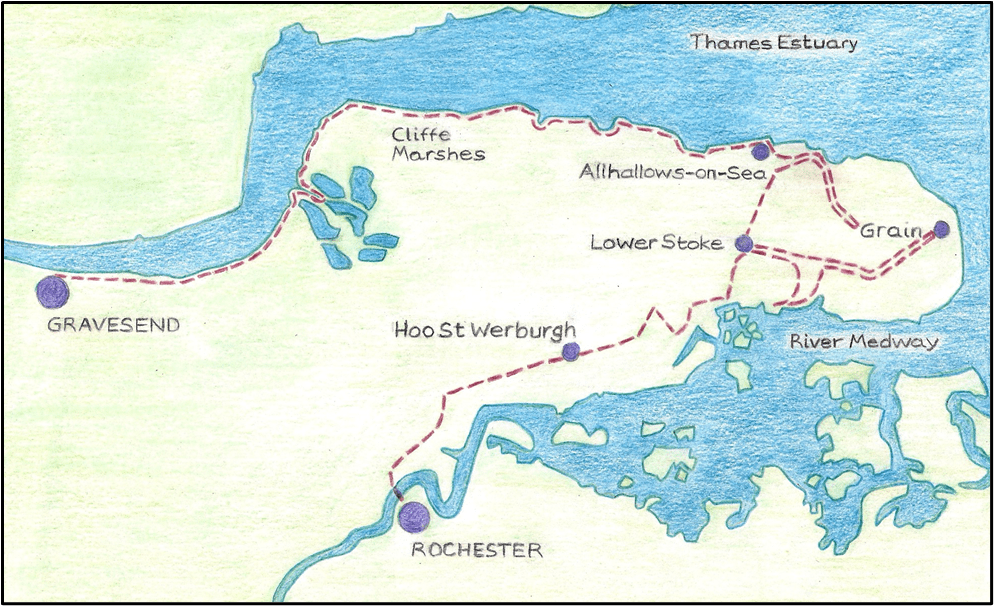
Two months after That’s It We’re Finished, the tunes in my head started to return. A fragment of Pulp had just popped into it as I clumsily hauled my bike off the train. “I don’t know why, but I had to start it somewhere. So it started… there.” “There” being Gravesend railway station, which looked neat but damp at 9.15am on this grey Sunday morning. The bottom of the soggy cloud didn’t seem all that far above my head and was a lowering weight unhappy enough to want to hang around all day.
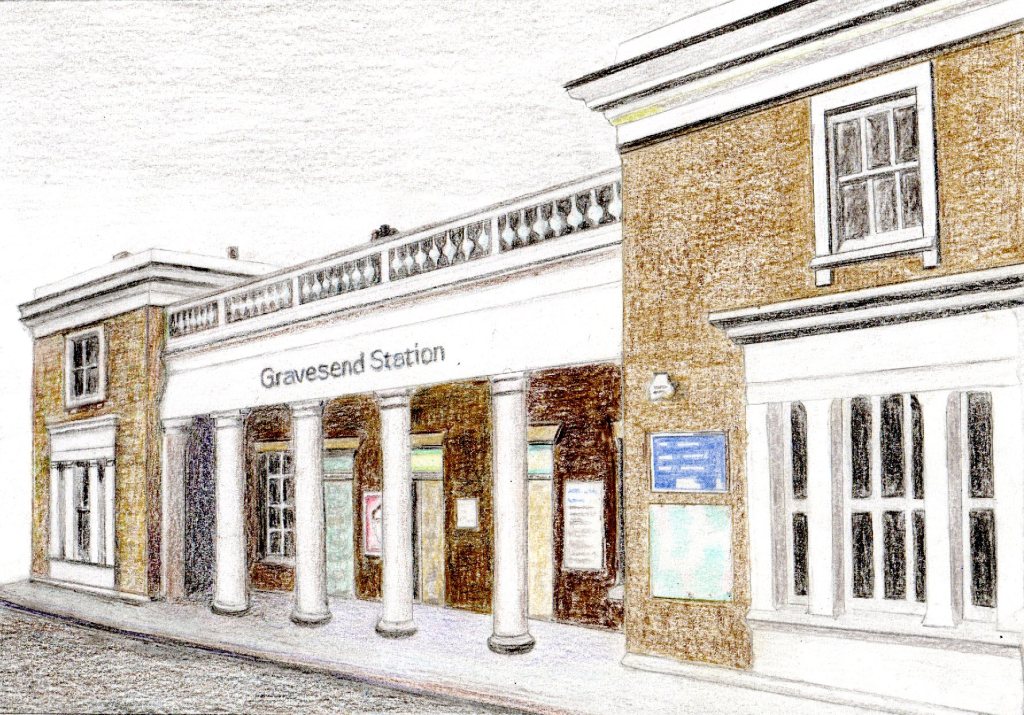
I declared this pedal-powered circumnavigation of Britain open, by taking what would turn out to be a grainy photo of the Victorian station front. Then I wheeled the bike down to the waterfront to find the start of the Saxon Shore Way, which I planned to follow whenever I couldn’t get closer to the sea. For the Way follows the ancient coastline as it was in Roman times, not as it is now. It was opened in 1980, so the Way itself isn’t that ancient, then.
As I was to discover, the Saxon Shore Way contains many signposts, each featuring a logo of a Viking helmet with horns on it. Didn’t I read somewhere that there’s no evidence horned helmets ever existed?
I neared the promenade and the sight of the estuary water gave me that first-glimpse-of-the-sea thrill I used to get as a kid, even if today’s drab scene was no deep blue summer holiday sea of childhood memory. Small boats gently rose and fell by the piers and jetties to which they were moored, cargo ships were making their way west upstream towards London, and sea birds circled overhead. Through the mist, Tilbury power station haunted the opposite shore.
After leaning self and bike against the promenade wall, I rummaged in my rucksack for the Ordnance Survey map: OS Landranger 178 – Thames Estuary (Rochester & Southend-on-Sea). As I unfolded it, with a weirdly slow motion eagerness, I found myself declaring this map open too, in a mutter I hoped no passer-by noticed.
Beginnings and endings
Being unsure where the Thames stops being a river and starts being the sea, it hadn’t been easy to decide where to begin the rides. I plumped for Gravesend because I found it an odd, ironic name for a starting point. It connotes a feeling of flat finality, of gothic endings in Victorian churchyards, yet there were many beginnings associated with this place: Cabot, Frobisher and Drake each once set sail from here.
Historical records suggest several origins of the name Gravesend from which to take our pick. Surely they can’t all be true? Graaf-ham (home of the lord of the manor’s reeve) and Grafs-ham (the place at the end of the grove). Then there’s Gerevesend (from the Saxon for the end of the authority) and‘s-Gravenzande (from the Dutch for a sandy area belonging to the count). In the Domesday Book of 1086, it was down as Gravesham and had been bestowed upon Odo, Earl of Kent, Bishop of Bayeux and half-brother of William the Conqueror in 1067. Odo ruled only nominally, for the people of Kent had fiercely resisted the Norman Conquest, earning themselves the epithet of Invicta, and were granted the status of a semi-autonomous county palantine. A century later, orthographic licence had tweaked the name of the settlement to Gravesende and in a court record of 1422 it had been transmuted to Graveshend, the place where the graves ended after the Black Death. Some years later, Geoffrey Chaucer’s pilgrims passed through on the hard shoulder of the old Roman road of Watling Street, while the sepia spectre of the Shipman told his Tale.
In later times, the naming of places was a headache for surveyors creating the first Ordnance Survey maps, when even locals couldn’t agree on what a place was called, never mind how it was spelt. Sometimes it’s hard to know what to believe.
Before embarking on this journey I knew little about the life of Charles Dickens, so I had no idea that he and his bride Catherine Hogarth spent their honeymoon here in Gravesend in 1836. Their bumpy ride of a marriage started in a white weather-boarded house called Craddock’s Cottage, where Dickens wrote his first novel Pickwick Papers. They say that nothing inspires quite like love, and when without a care Catherine let her hat drop to the floor that first evening, she may have had no inkling she would inspire her new husband to father ten children and write the fifteen novels it would take to feed and clothe them. In the process, Dickens invented a total of 13,000 characters, 318 of whom were orphans. All this to ensure his own children didn’t end up likewise. Nor perhaps did Catherine anticipate the unhappiness the master storyteller would bring to her own tale.
A man of many parts
On top of all that, our energetic hero also edited various magazines, wrote and produced endless plays, and went on many lucrative reading tours, at home and abroad. These tours usually involved a few hours’ performance in the evening followed by a lavish meal. On one tour of the United States Dickens was unable to do justice to such hospitality because he suffered from gum disease and neither of his two sets of dentures were functioning correctly. Long-distance travel was slow and uncomfortable in the age of the stagecoach and Dickens’ life was made much easier with the arrival of rail travel. That is, until one tragic day in June 1865 when a train he was travelling in derailed at Staplehurst in Kent, killing ten passengers and injuring many more. He never fully regained his health.
Just down the road from Craddock’s Cottage is The Old Forge at Chalk, the inspiration for the forge in Great Expectations. This is where Dickens had blacksmith Joe Gargery spend long days at it hammer and tongs, red-hot iron on anvil. The last blacksmith at the Old Forge retired in 1953 and the building is now listed. You can probably picture its once soot-encrusted internal walls now stripped-to-brick, brushed and nicely matt-sealed; an estate agent’s dream.
Gravesend has witnessed endings, too. Pocahontas ended up in a grave here in 1617, after a short and tragic life. She was a Native American captured by the English in 1613, and repeatedly raped before being encouraged to convert to Christianity. While in captivity she met John Rolfe, a tobacco planter who desperately wanted to know her tribe’s secret process for curing tobacco. So he married Pocahontas, or Rebecca as she had by then been renamed, conveniently became one of the family and was let in on the precious knowledge. In 1616, they sailed to England where she was presented as a “civilised savage”, to dispel rumours about wild murderous Native Americans. The following year, the couple set out to return to America, but only got as far as Gravesend before Pocahontas fell ill, was taken ashore and died. Some say she was poisoned.
She wasn’t even yet twenty-one. I later read there’s a statue of her in the graveyard of St George’s church. I’m glad I didn’t visit for she looks remarkably like Sophie. One of the local ferry boats is called the Princess Pocahontas. Which is nice.
This town…
Despite the unpromising name, Gravesend was a more attractive place than I’d expected. The town centre had a haggard run-down look about it that was interesting, almost ghostly. Nearly all the shops in the cobbled street leading down to the promenade were closed at this early hour, but many looked closed for good.
In contrast, I felt open for business, full of a curiosity and anticipation that cut through my tiredness. I was looking forward to doing something, rather than spending another weekend trying to avoid my ex-spouse-in-waiting for a whole two days in a small flat. Well, I say ex-spouse-in-waiting, for when does a partner stop being a partner when you split up? What are we called before final divorce, when we become fully ex? Is there a word for the transitional phase, like the estuary between the river and the sea? Perhaps “soon-to-be-ex-spouse” would be better than “ex-spouse-in-waiting”. Yes, “soon” sounds better than “waiting”.
A little knowledge being an underrated thing, I’d visited the local library at home before embarking on this voyage of discovery. There were few relevant books that weren’t already out on loan, though. I did find one book called The Sea on our Left, about a couple who walked around the coast of Britain and nearly split up in the process. I was about to do it the other way around, having split up beforehand, and on two wheels rather than two legs. I’d also heard about the World Wide Web, but the library didn’t have any computers yet and I certainly didn’t own one. The only person I knew with access to the marvellous new world of the internet was the studio manager at Saatchi’s, but she worked on the day shift and her computer was out of bounds to us night workers.
I put the map away in the front pocket of my anorak, where it would be easier to get at, and looked out over the water, picturing how Gravesend might have looked in its heyday, when hundreds of trading ships made their way under sail, up and down the Thames estuary, chaotic silver highway and major artery of empire. As a child I was fascinated by tales of the Royal Navy during the Napoleonic wars and read all of CS Forrester’s Horatio Hornblower adventure books, usually by bunkbed torchlight, imagining I was on board a frigate, unable to sleep for the massive sway of heavy seas and the swish of wave tops sliced by vicious gusts of wind, waiting for the next watch when I and my fictional heroes would continue to battle on against all the odds, to victory.
Ghosts of industry
Continuing onwards and eastwards along the promenade and through the streets by the Custom House, I passed behind disused old warehouses and wharves, the cranes that must once have loomed over them long gone. I felt the aura of their dilapidation, the crumbling, dirty old buildings with their black walls and forlorn atmosphere of history forgotten. The air of neglect and foreboding drew me in under a sombre sky rubbed with dirt and full of rain.
Gravesend is the home of the Port of London Authority and has been the river’s guardhouse and gateway since the 14th century when Searchers and then Tide Waiters were appointed to stop and search all vessels and impose duties on their cargoes. Their captains also had to swear on the Plague Bible that there was no illness onboard. By the 17th century there was so much shipping and so many Tide Waiters, that they resorted to using Gravesend’s inns as offices, which makes you wonder how much ‘leakage’ there was of the duties levied; nice little earners lubricating the arithmetic. The problem was solved by the construction of the old Custom House in 1782, replaced by the current one in 1815.
The river that wanted to be a sea was pale, as if the remaining tinges of silver and green had been washed out by the tide. Looking up, the sky was now a light grey above a dark base of heavy pewter clouds, layer upon layer, undefined and out-of-focus. Peeping at it hurt my eyes.
A different kind of cycle lane
The cycling became difficult on the grassy-banked sea wall that, according to the map, extended for the next fourteen miles along the top of Kent, and I hoped it wasn’t going to be like this all the way. For the most part, the ground was bumpy, muddy and stony. For the rest, it was clover-thick springy grass, no easier to cycle on. In spite of this, I was enjoying it all much more than cycling in London; it was as if I were meant to be here. Before me were the broad vistas of the estuary and the marsh, and not too much wind – the peace and quiet of the high and wide outdoors. The only sounds were of sea birds crying, marsh birds twittering and the reverberating bass throb of enormous cargo ships making their way upriver.
At Higham Saltings, the marshland spread on both sides of the king-of-the-castle raised bank, and the salty sea-and-marsh tang was more perceptible on the breeze. It’s because a salting (apart from being a lovely word) is an area of coastal marsh covered by seawater at high tide. The cycle of flooding and evaporation with the flow and ebb of the tides causes the air to be permanently super-salty. I stopped, closed my eyes and gulped it all in, to make sure I really was here and not still suffocating in London. It was wonderful to breathe properly after so many months gasping in despair and frustration. It began to drizzle; I opened my eyes and looked over towards Cliffe Fort and the massive Coryton oil refinery beyond, with its brooding presence and burning flares.
Unimaginably vast amounts of puff and sweat must have gone into building, maintaining and strengthening the sea wall over the centuries, not to mention the huge task of banking-in the unending mudflats and saltings, then cutting drainage ditches between them so that over time they were no longer covered by the sea at high tide. To think that the North Kent Marshes once extended all the way from Dartford in the west to Whitstable in the east. Mile after mile of shoreline, shifting, amorphous, not defined by cliff or even beach, but as hard to grasp as the mists that rolled and swirled on the marsh at night. The sense of vastness added to the glorious feeling from cycling and walking in this place; I could feel the cobwebs starting to shake and fall from my tired mind, to be replaced by birdsong and occasional ships’ hooters.
Rust never sleeping
Reaching Higham Creek, I followed a gravel-and-stone path north past Cliffe Fort, denoted on the OS map in expectation-raising gothic script, but in reality a squat, square overgrown disappointment. Behind it was abandoned machinery for a long-disused gravel works. Fascinated by this arrangement frozen in time, I stopped and leaned the bike against an abandoned conveyor belt that rose up at an angle to the point at which it presumably once fed a hopper long since gone. I studied the world of rust on the old metal: dried-blood-red and black speckles among saffron flakes and pale verdigris lichen spots.
Beyond, the rocks at the high-tide mark were strewn with all kinds of debris, presumably washed up from the estuary. I wandered around older debris too, including the spiky weathered shell of a large old wooden boat. The Hans Egede was a three-masted ship built in 1922 in Denmark and named perhaps after the Danish-Norwegian missionary of whom there’s a statue in Nuuk, Greenland. For many years, she was a coal and grain hulk in the Medway estuary. At the end of her working life she was beached here on the estuary margins where she remains sticking out of the ancient slime like a partially disinterred skeleton, all ribs and rotting superstructure.

There was a charm to the odd almost-beauty of the natural scenery, roughened by remnants of old industry and pock-marked by random small piles of rubbish, obscure faded offerings at some imagined path-side shrine.
A man with a job to do
I hauled the bike over a stile, mounted it awkwardly and followed the track winding through gorse bushes. The cycling here was easier, and I soon emerged at the end of Cliffe Creek, at the edge of a huge rubbish dump that looked decidedly less than tidal in origin. The next nine miles were laborious yet steady along the top of the high, grassy bank that extended north east and overlooked the estuary on the left and marshland on the right. It would always be that way round: the sea always on my left. The sea wall was even more substantial here, higher and wider, as if it were gearing up for when estuary would become full-on sea coast. On the landward side, it sloped down to a greensward, which sometimes made for better cycling, and then to a creek or large ditch running parallel.
Ahead stretched Cliffe Marshes: flat as Holland and interlaced with ditches and fleets, grazing sheep and hosts of birds. It was strange to think that as recently as the 13th century this was all sea. Peering over the wall on the bank top revealed a small pebble beach, and, across the estuary, the Tilbury refineries, Canvey Island and Southend beyond. The path continued for miles, punctuated by stiles in fences and ever more laborious liftings of the bike. Past Lower Hope Point, past the strange-looking arrangement of sixteen sheds above Cliffe Marshes, all along the shore to Egypt Bay. Here, the bank path was closed off, so I tut-tutted a detour around the back of the tidal marsh, along a narrow bank with long grass, overlooking birds and rabbits in the marshland below.
Sleeping with the ghosts of hulks
At Egypt Bay, I laid the bike down, took my rucksack off and lit a cigarette. Between drags I flicked through Bea Cowan’s Saxon Shore Way, to check that this was indeed where prison ships were moored during the Napoleonic Wars. I squinted across the grey water to where I imagined they would have been, then crushed the cigarette underfoot, despite the dryness of the grass that invited me to sit down. I closed my eyes to better conjure up old decaying hulks no longer fit for service; cribbed and barred, rotting to death and stuck fast forever to the mud of the estuary bed by ancient rusted chains manacled to great heavy anchors that made these once-proud craft prisoners too. I could hear the moaning of convicts and prisoners of war incarcerated between the low decks of the foetid hold. The ceilings were too low for the inmates ever to be able to stand, so they stooped, or lay down on the bare floor in the dark, crowded spaces, clamped in irons.
Thinking about it made me feel claustrophobic. It also made me ashamed that I often felt like a prisoner, and like most prisoners, considered myself innocent. Yet really, I didn’t know I was born. I jumped to my feet and stretched my arms above my head, just to feel that I could. Then I lay down again and drifted into a loose doze.
These poor souls subsisted on brackish water and meagre stale or rotten food. The scuttling, scraping presence of rats made sleep difficult. Clothing turned to rank rags and the skin it tried to cover became flea-ridden, crawling with flies, and exposed to contagious diseases. There was no sanitation. The only escape from this nightmare existence was in death, and even then, whole days might pass before your corpse was removed and buried, a concern for those prisoners of a religious disposition. Between 1776 and 1795, 2,000 out of 6,000 inmates of the hulks died. James Hardy Vaux survived his sentence on board the aptly-named Retribution:
“There were confined in this floating dungeon nearly 600 men, most of them double ironed; and the reader may conceive the horrible effects arising from the continual rattling of chains, the filth and vermin naturally produced by such a crowd of miserable inhabitants, the oaths and execrations constantly heard amongst them. On arriving on board, we were all immediately stripped and washed in two large tubs of water, then, after putting on each a suit of coarse slop clothing, we were ironed and sent below; our own clothes being taken from us.”
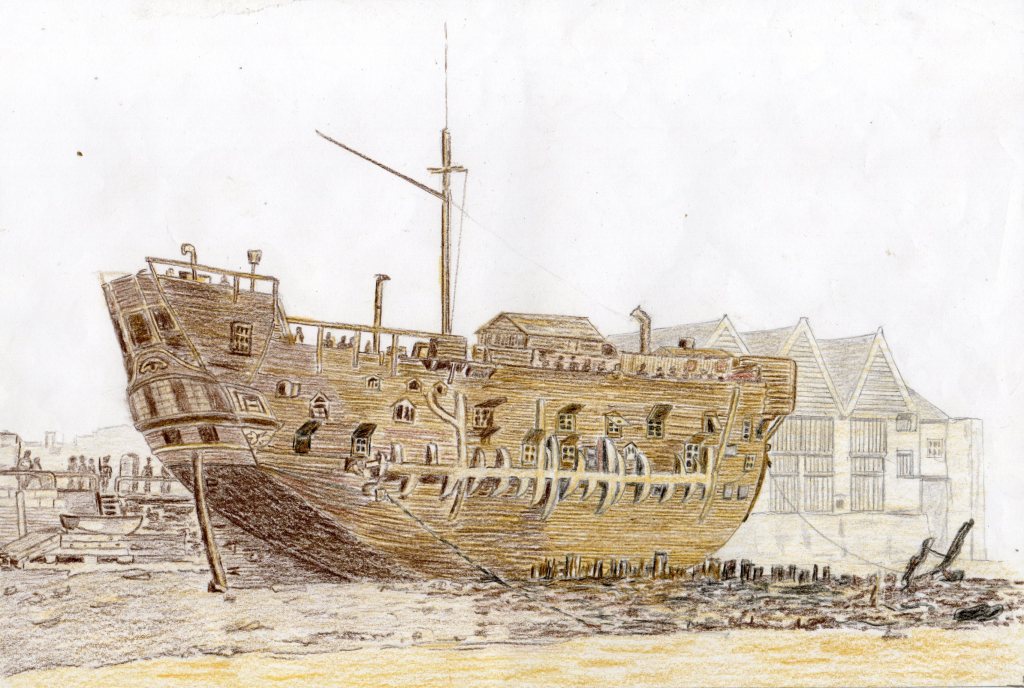
Prison hulk Discovery at Deptford, 1829.
It fell to the authorities to make sure conditions were worse for prisoners than for the poorest of those on the outside. By all accounts they did a pretty good job of it.
This stretch of marsh is where Pip spent the first part of his life in Charles Dickens’s Great Expectations, and where Pip’s much older sister, Mrs Gargery, raised him “by hand”, which is to. His refuge from said hand was in the friendship he forged with the blacksmith, Joe, Mrs Gargery’s good-hearted husband.
In my mind’s eye I joined Pip and Joe in the heat of the forge, catching the last echoes of clanging, clinking and ringing of metal on metal down the years, accreting in the air all day long, every day of the week except Sunday. Probably the only sound to break the quiet murmur of daily life in nearly every village in the country in the early to mid-19th century. Pip and I watched through hands splayed on our faces to protect against flying sparks as Joe performed the final act: using the long-tongs to plunge the red-hot metal into the quenching trough in a hissing mist of scalding steam. It was thirsty work and dangerous, too. It would perhaps have been even more dangerous had the blacksmith’s daily beer consumption matched that typically given to refresh and placate labourers on one large Dorset farm, according to GE Mingay in Rural Life in Victorian England:
“…the men were allowed a gallon a day: a quart for breakfast at ten o’clock, a pint at half past eleven for luncheon, a quart during dinner between one and two o’clock, a pint at four, with something to eat at five, and the rest when work was finished for the day.”
Harvest time must have been fun. By the time the wheat was half cut, most of the workers would have been likewise.
The harsh marsh
The marshes in olden times were isolated and the few roads poor. In bad weather many villages were cut off for days at a time, if not weeks. Few working people owned a horse; walking was the only option. In 1892, Anderson Graham wrote of the farm labourer that “a ten-mile journey was an event that kept him in talk for a life-time. Even at this day I know rustics who live within that distance of the sea and yet have never beheld it.”
Pip’s reflection in Great Expectations on what drew Joe and Mrs Gargery together is that: “She was not a good-looking woman, my sister; and I had a general impression that she must have made Joe Gargery marry her by hand.” In my dream, dissolving bands of early morning ground haze drifted invitingly around Mrs Gargery, forming a wispy, silken robe that over time stiffened into an impenetrable blank pea-souper of grey cotton smock. Then, estuary day shrank to cold damp dark night. I passed gibbet, beacon tower and battery mound. The clang of a sheep’s bell, muffled by drifting fog across the marsh flats and through the old churchyard where presences of family faded with each passing year. Then the sudden appearance of the escaped convict:
“A fearful man, all in coarse grey, with a great iron on his leg. A man with no hat, and with broken shoes, and with an old rag tied round his head. A man who had been soaked in water, and smothered in mud, and lamed by stones, and cut by flints, and stung by nettles, and torn by briars; who limped, and shivered, and glared, and growled; and whose teeth chattered in his head as he seized me by the chin.”
I awoke with a head full of aching wool and slowly got to my feet. There was no one about, though it must have been one o’clock by now, I’d seen hardly anyone since the promenade at Gravesend – just a couple walking a dog, and a few anglers.
Around West Point the path became stony, so I walked the bike for fear of getting a puncture. After St Mary’s Marshes, the bank narrowed and became lower and lower until only the path itself was left to meander at the level of the marsh, right on the shore. What a lovely smell of salty coast air. What a shame about all the rubbish lying around: torn plastic bags flapping in occasional gusts, pinned to the ground by broken glass and soiled cloth, car batteries and gutted old fridges leaking poison into the ground. Fast moving consumer goods now stock still, corroding, spent. I wondered how the fridges got here; too heavy to carry far and no road nearby.
As I trod a little further on, my nostrils were overwhelmed by a pungency of herb, a wonderful concentrated smell, like coriander, released by my crushing footfall on clumps of Sea Arrowgrass. You can eat the leaves but do avoid the greener parts, which store hydrocyanic acid that’s not awfully good for you, because it’s essentially cyanide. Danger lurks in all beauty.
Holding hands
A young couple approached slowly on the path ahead. Smiling and laughing shyly, side-to-side as well as side-by-side. Near each other, but without actual physical contact, as if it were only their first date. As they drew near, I looked down to avoid meeting their eyes, though I did hope they’d start holding hands soon, and always as a display of affection, never of control. I remembered holding Sophie’s hand, in the days before we nudged caution into a light breeze and moved in together. As Dickens put it in The Cricket On The Hearth, “We forge the chains we wear in life.”
In Great Expectations, Pip longed to hold hands with Estella, but I’m not sure a polite handshake counts. Once the couple passed behind me, I looked up and over at the further grey distance: a line of electricity pylons and what looked like a great grey power station.
I continued pushing the bike along the stone and seaweed beach, concentrating on the low buildings of Allhallows-on-Sea up ahead. This definitely felt like seaside coast rather than an estuary-edge muddy mess. But there was hardly a breath of breeze, so it was a sea with a surface barely moving, the shifting greys all darker than the pale grey of the sky above it, and the greys all complementing the green of the marsh.
It was a shame the tide was in. During the Battle of Britain, a Messerschmitt shot down a Spitfire over the River Medway. The pilot bailed out and was rescued, and the plane crashed onto the tidal mudflats just here. I guess it was too much to hope it would be visible today, but just the knowledge that it was there made my spine shiver at the knife edge thrill and fear of warfare.
Never in the field…
The Supermarine Spitfire remains a symbol of the backs-to-the-wall defiance of those who took part in the Battle of Britain in 1940. After being taken to see the film Battle of Britain aged 11, I was so fired up that I asked Santa, who had only recently morphed into my father, for Airfix model kits of both the Spitfire and its arch-enemy the Messerschmitt ME109E so I could play out for myself the Spitfire’s superior speed and manoeuvrability. I remember like yesterday painting its underside duck egg blue and being impatient for the paint to dry so I could apply the decals and other finishing touches, before mounting it on a transparent plastic plinth.
The real Spitfire’s advantages also had a downside; if you tried to turn too suddenly you risked losing consciousness. As Keith Ogilvie, Battle of Britain Pilot with 609 Squadron, said: ‘Two hours a day in these thunder buggies and you are poohed right out.’
As I looked out to where I thought the plane might have crashed, my imagination played out my own version of the dramatic event.
Bernie knew his plane had been hit when he heard a loud clattering behind him and the fuselage jolted. He had no inkling of where his attacker was and there was no time to think; no time for anything. He just had to get out. With one hand he pulled the joystick to lift the plane’s nose into a shallower dive, while with the other scrabbled at the cockpit cover as he felt himself succumbing to the increasingly strong smell of smoke and burning through his mask. He was now a mass of panic and claustrophobia and screamed ‘Oh God! Oh God!’ over and over. At last the cover budged but the relief sublimed instantly into deadweight vertigo as the flapping cover was wrenched away by the screeching wind and he hauled himself over the edge of the cockpit and rolled out, into the void. He counted to three: ‘Fuck! Fuck! Fuck!’ then pulled the parachute cord, losing control of his bladder as the parachute opened and swung him upwards and back, his stomach churning.
As the wind blew him sideways and around, he felt more than heard the explosion of the crash as the heat blast lifted him up again. The large plume of smoke rising at an angle from where what remained of the plane was sinking into the mud by the shore engulfed him. As the air cleared he noticed several children, just dots on the ground, running towards the crash site, followed by a few larger dots. One of the children stopped, seemingly pointing up at him. He looked down at the sea far below between his legs, then to the side and realised he was being blown gradually, gratifyingly inland. Sheep scattered in an arc as the lumpy marsh rushed up and hit him before he could get his feet and knees ready. He lay still for a full minute, his mind blown by the shock and relief. He tried to stand up but his ankle raced with pain and wouldn’t let him, so he sat back down and started to gather up his parachute as best he could. It was still a bright early morning, and it couldn’t have been more than an hour since the start of this, only his third sortie, yet he’d already lost a plane, buggered his ankle, and blown his chances of seeing the lovely Mary at church parade. But he did thank God he was alive.
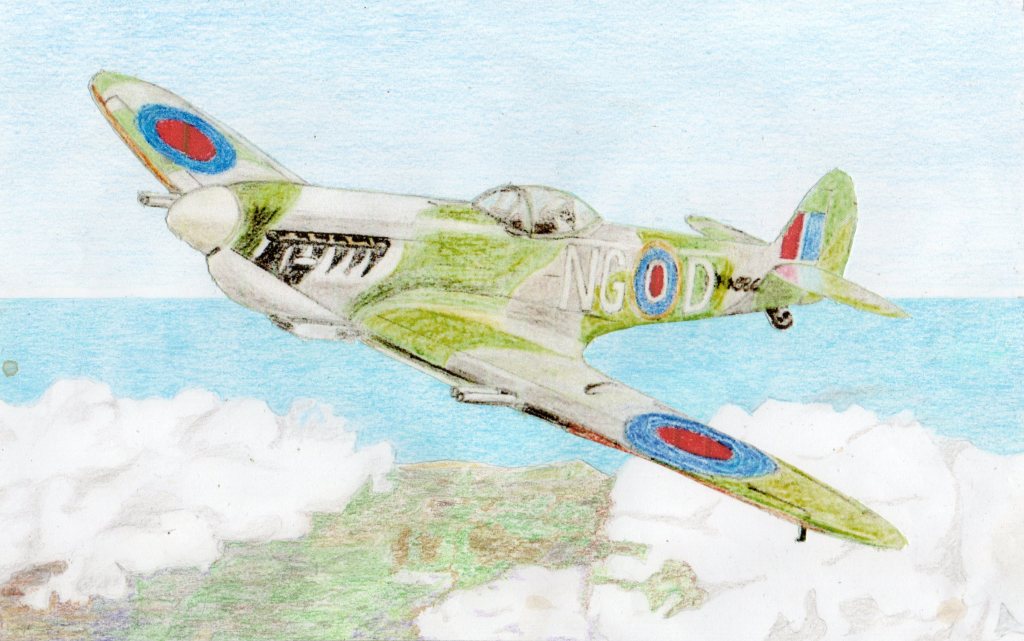
Supermarine Spitfire without streamlined transparent plastic plinth.
Static for the people
Allhallows-on-Sea is a giant caravan park and a step back in time: a federation of sites, each with static caravan and cabin units arranged in ruler-straight rows. The caravans looked too large for the narrow roads that must have brought them here. Many had flower beds and window boxes, and some had modesty skirts to hide their sexy wheels. I didn’t realise places like this still existed, replicas of 1970s childhood holiday settings, with the nod-to-modern-times addition of a security post at reception and a notice warning would-be trespassers that CCTV was in operation – a piece of the present to preserve the past. I got off the bike and pushed it with one hand away from the shore towards the pub shown on the OS map.
I will never tire of the beauty of these maps and all their coloured lines, blobs and squiggles, printed so precisely. This marvel of topographic depiction, here in my hands, is the culmination of myriad gradual steps in technology over centuries. I mentally saluted the achievements of the scientists, some of them from Kent, such as Leonard Digges of Canterbury, who invented the theodolite in the 16th century. And the artistry and attention to detail of the cartographers. It can’t have been easy, map-makers were often unpopular among those being mapped and in the 19th century many objected to surveyors poking their theodolites into other people’s business, to paraphrase Rachel Hewitt in Map of a Nation.
The British Pilot is a large pub, probably built in the 1930s, that overlooks the marsh a quarter of a mile from the sea. While locking the bike, I felt it incongruous that a large ordinary pub from a 1930s suburban housing estate could have been transported to such a strange remote location.
On entering, I discovered that it too is a trip back in time, the kind of place Bernie and Mary might have cycled to for lunch on a rare wartime day off together. The décor was old-fashioned 1950s-style flock wallpaper, a well-worn red carpet, a couple of old photos and a few over-polished fireplace ornament-tools. Piped music from the same era, a lurid ache of sugary violins, swirled in the stale cigarette air. A replica of a seaside Sunday England a lifetime ago: The Clitheroe Kid and Sing Something Simple on the Home Service radio programme. But it was 1998 now – it felt like I was in a living museum.
For all that, the atmosphere was lively and the bar staff friendly; people of all ages enjoying a Sunday lunchtime pint. I found a small table near the large fireplace piled with logs but fire unlit, as far as possible from the happy families. Gazing at my pint conjured a swirl of childhood memories that finally settled on a dim monochrome photo of yours truly on a cold, windy Hayling Island, aged six. Mummy’s little soldier looked so ridiculous sitting on a coin-operated rocking horse, wearing an oversized raincoat, a thin plastic policeman’s helmet and a forced grin.
Fast-forward to just ten months ago. I was still on Hayling Island and it was still chilly and overcast. Sophie and I had gone there for the weekend to get away from it all. But it seemed we’d taken it all with us as we rode our hired bikes uncertainly from Havant, wobbling over the bridge and onto the island. The topic this time was me swimming widths not lengths, which before long became a metaphor for every other real or imagined failing. By the time we reached South Hayling I could take no more. I got off the bike and sat on a nearby wall with my head in my hands, trembling, trying not to cry.
The British Pilot’s hidden sound system was now treating us to Gilly, Gilly, Ossenfeffer Katsenellenbogen-by-the-Sea-ea-ea-ea-ea. Max Bygraves was always on the telly when I was a kid. The clean-cut coiner of “I wanna tell you a story” entertained us on a Saturday night with his comfort schmaltz-music, while his alter ego Bad Max was backstage, busy fathering his several illegitimate children. I tried but failed to adjust my mood to the cheerful blandness of the song. Sometimes you’re just better off with the tunes in your head. I no longer felt I belonged in this happy pub – I was a Family Favourites fraud. So I left, pint unfinished, in case the next tune might turn out to be Stranger on the Shore. I was annoyed with myself for having come all this way, just to nurse a morose glass on a soggy beer mat.
In a heavy mood, I set about arranging bike, map and rucksack and headed back towards the sea. I swore in frustration when the bike got caught in the top railing of a stile I was lifting it over, and I was still muttering as I rode southwards down a path through what was more like field than marsh. Back on top of the bank by the sea, the going was very stony again, among the anglers and after-lunch strollers, and a solitary bird-watcher. While passing along Yantlet Creek, some way further on, the back wheel of the bike worked itself loose, rubbing against the frame, and the saddle became loose too. Great. I had packed a bike spanner and a rudimentary puncture kit, and wasn’t sure how to use either. But I surprised myself by swiftly fixing both wheel and saddle. Needs must when the devil pedals, for sure. With my new-found confidence I thought about maybe one day finding out how to raise the saddle while keeping it the right way round; it would certainly make cycling less uncomfortable. Perhaps I could even consider aligning the brake pads more closely to the wheel rim for better braking too.
But what if I hadn’t been able to sort the bike out? As I set off once more, it dawned on me that I would have been stuck out here alone, in the middle of miles-from-anywhere. It wouldn’t be the end of the world in fine weather, but not so clever when it could start raining at any moment. What would I have done? I had no mobile phone and I hadn’t noticed any public call box since Gravesend, not even in the British Pilot, which I supposed would be closing soon anyway. The absence of people on this rough stretch heightened the sense of remoteness and isolation, and the vulnerability of relying on a couple of thin metal wheel rims and some even thinner spokes, a few bits of rubber and the air forced into them by my own unsure hand. Once night fell it would get harder. I had no torch, no umbrella and no bank card; just a few quid and a return ticket home. My instinct would’ve been to try and soldier on through the dark, but what if it was cold and wet, with clammy Magwitch mists crowding round? I wasn’t at all sure I would be able to find my way to shelter. So, how bad would it have to get before I plucked up the courage to knock on a stranger’s door, if I could find one?
Sheep and cattle dotted the fields between the ditches west of Yantlet Creek. The Isle of Grain, to the east, was once an island, before farmers filled in part of the creek hundreds of years ago, in so doing removing themselves from the Christmas card lists of the boatmen who had used it as a shortcut to the Thames. A few houses and farm buildings lay under the gaze of the power station looming behind them in the distance. I’d seen many electricity transmission lines earlier that were all now converging here. Wary ewes guided curious lambs away from the fence as I trundled by.
At the southern end of Yantlet Creek I could go no further. Though the OS map showed a lane to Grain, I was confronted by a busy, angry sign that said “DANGER! MINISTRY OF DEFENCE RANGE. DO NOT PROCEED BEYOND THIS POINT.” Without delay, I turned round and retraced my route back to Allhallows-on-Sea, for fear of getting hit by unfriendly fire. The only other shortcut, to Binney Farm via a gap between ditches, was being guarded by an attentive bull whose assertive demeanour persuaded me not to try passing through. Maybe painting the bike red hadn’t been such a good idea, and the flapping of my red anorak in the light breeze probably didn’t help much either. Had I been able to continue, I might have glimpsed the London Stone. A line drawn from it to the Crow Stone, a corresponding obelisk on the other side of the estuary near Southend, denotes the eastern boundary of the City of London’s historical river rights on the Thames.
From Allhallows-on-Sea to Lower Stoke was unremarkable cycling; it could have been untidy semi-rural semi-suburban semi-anywhere. Turning east along the main road I started feeling tired and fed up, having added miles to my journey by skirting the firing range. Passing under a transmission line I heard humming and crackling overhead – the soundtrack to the Isle of Grain.
If Kent is the garden of England, you’d think a place called Grain would be its bread basket. But Grain produces no grain, only sheep and electricity. The village of Grain is a depressing yet fascinating place. To approach it you pass what seem to be British Gas installations, fenced-off areas that maybe contain underground fuel storage tanks, three level crossings, and the increasingly convergent overhead transmission lines. More crackle and hum; felt as much as heard. Grain is unusual in that it doesn’t appear to be twinned with anywhere and there’s no jolly road sign thanking you for driving carefully through it; the latter probably because you can’t drive through it, only to it. There’s nothing wrong with Grain, it just felt strange being there – a patch of frayed yet tidy housing estate perched at the end of land. Old-fashioned and serious, like the council estates of childhood, each house looking the same but each with its own back garden and own back story. Concrete washing line posts crumbling into the sea, along with old World War II gun emplacements and the faded, colourised hopes of a generation’s Great Expectations.
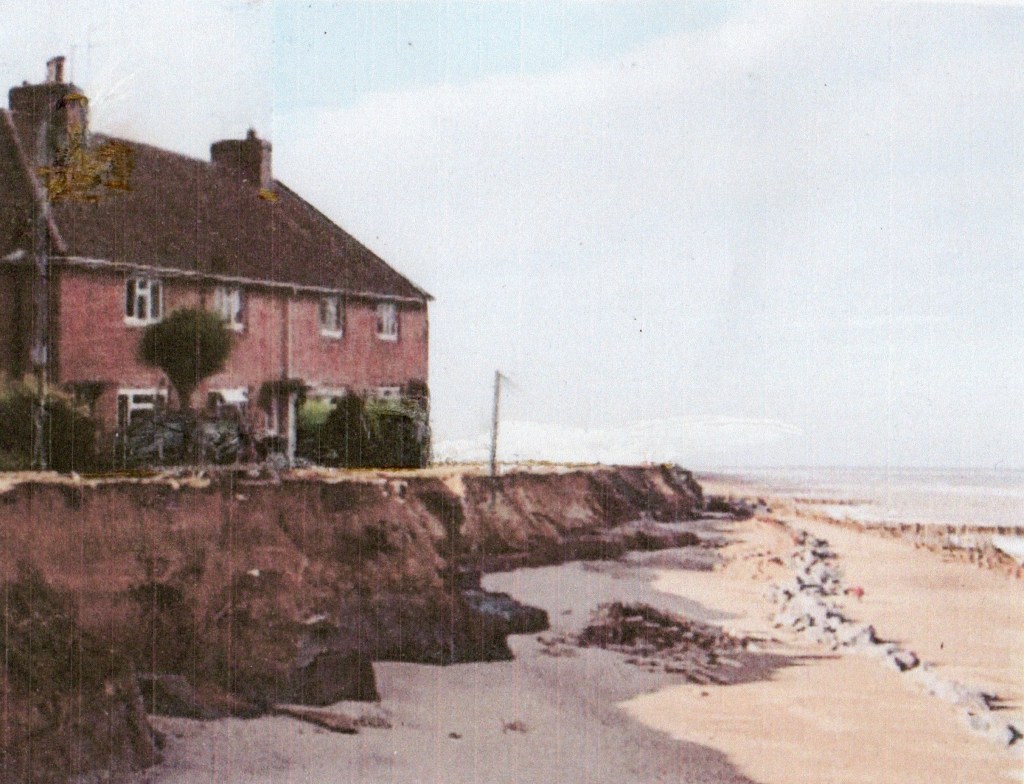
The council estate at the edge of the land.
Presumably everyone in Grain works at one of the power stations or patrols British Gas’s mysterious perimeter fences, consoled by the security of a regular wage and the beauty of the surrounding open coastal marshland. It looked as though it would get dark before too long, so rather than try the shore path south from the seafront at Grain (with no apparent means of getting past the more southerly power station), I turned back once again. Travelling towards Lower Stoke revealed an expanse of marshland to the south west: Stoke Saltings, according to the map. I turned off the main road and followed the bank south west along the shore.
The sun remained hidden by cloud and the light was starting to fade, but I still had a long way to go. The view of the reeds and islets silhouetted against the sky and the Medway river beyond was captivating in its transience, and made me forget my tiredness for a while. A man was out shooting with two youngsters, showing them how to handle a gun. Were they after ducks or rabbits? There were plenty of both around. The path turned to the north-west, back towards the main road and away from the fading marsh and river, where the tide was now low. Small boats rested lopsided in the mud, which showed off-white against the whiter-white of the remaining water in the strange evening light. The lowness of the cloud cover was less obvious now; you don’t much notice a low ceiling in a darkened room.
Back on the main road, my gloom started to lift. There would often be times like this, when I’d feel relaxed and absorbed in my surroundings: watching the road, admiring the scenery, glimpsing wildlife, my mind tuned to the weather, the birdsong, the rumble of tractors and the palette of countryside smells. Then I would receive a jolt, on this occasion the sight of a dead pheasant by the side of the road. I stopped and got off the bike to have a closer look. Beautiful reddish-brown wing feathers ruffled in the breeze, but I could tell that the bird was dead. The body had a soft almost breathing solidity, being so recently alive. There was no visible injury, no pool of blood. I wanted to freeze this moment of its sudden death, preserve the freshness of the bird. Stuff a dead animal; I wondered if people still do that. I made a note to start compiling a little Observer Book of Roadkill.
At Stoke I turned off the main road, a decision that was rewarded by easy, rolling pedalling along a gently undulating lane. I soon passed a small old stone church inside which a Sunday evensong hymn echoed. I turned to look and was surprised by the unusual stub of the church tower. A moment later serenity was strafed by a gunshot, alarmingly close by. I’m not paranoid or anything, but I did suspect the Danger Area unfriendly fire and the father-and-son shooting party of having joined forces to carry out a pincer movement on me and my bike. For some reason, I found myself humming The Tornados’ Telstar, but as a hymn rather than the early 1960s pop instrumental, with belting bellowing church organ instead of the nasal electric lead guitar riff of the original. Telstar was one of the first tunes I remember hearing on the radio. I was a little frightened of it and I think my sister Lily was too – she with whom I’d once bet £1 (twenty weeks’ pocket money at a shilling a week, aged eight) that I’d never get married.
Hoo St Werburgh is not like Grain. It’s the kind of place that twins promiscuously and whose appreciative residents line the streets and shower you with flowers for driving carefully through, past the handful of shops and the Hundred of Hooschool. What a lovely name for a school. I decided to make it the first entry in my Observer Book of Brilliant Kent Place Names.
It started to rain. The drops cut golden daggers through the dazzle of the street lamps and car headlights. Headlights? All that meticulous planning and bike lamps were yet another thing I’d forgotten to pack. On top of that, I realised that in my shorts and thin windcheater I’d soon get soaked if the rain persisted. My rucksack contained maps, notebooks and a disposable camera, but no spare clothing and nothing properly waterproof. I soon found that whenever I forded one of the rapidly-forming puddles by the side of the road, jets of cold muddy water shot up my back; taking the mudguards off the bike hadn’t been such a good idea after all. I must be weather-naïve: it’s going to be the same tomorrow as it was today, and if it’s raining here it must be raining everywhere. There wasn’t now enough time or light anyway to take a look at Kingsnorth Power Station or Upnor Castle (the latter built in the 1560s to protect Chatham from the French). So I persevered along the footpath, tasting the electric metal of the rain as I wearily followed the urban clearway around roadworks and roundabouts, bathed in the yellow cast of the street lamps of Wainscott, Frindsbury and Strood. Little old semi-detached me, feeling I was simultaneously on every dreary 1930s housing estate I’d ever visited.
Then finally, triumphantly, I crept over the Medway Bridge and into Rochester for a pint in a friendly old pub crowded with students. At the next table was a group of youngsters, one of whom was talking about his band that had just finished touring. I got the impression it was a well-known one, as his friends seemed in awe of him, despite his down-to-earth manner. I smiled to myself, wondering if my friends would hold me in such awe once I’d finished my own particular tour. Probably not, since I hadn’t told anyone I was doing it, which made it feel all the more like an adventure. Besides, I don’t recall ever getting that kind of attention even when I was in a band too.
When I finally got home, I padded to my room and fell straight asleep and into an inevitable dream that I was still cycling. My feet and pedals were still powering round and round in muscle memory, the wind in my hair. I was an exhausted Jack Russell terrier lying on its side in its sleep, feet scrabbling the air as it chased an imaginary rabbit into a lovely muddy ditch, through a scrubby hedge and up onto a large green field, running free.
 The Kent Coast Cycling Lesson
Leave a comment